The Numbers Man: How Mathematical Thinking and Military Service Shaped Our Family’s Success

I wrote this life story for my dad before his 93rd birthday in October 2025. I gave him a choice of three headlines. On his birthday, he chose that one (above). He died 12 days later.
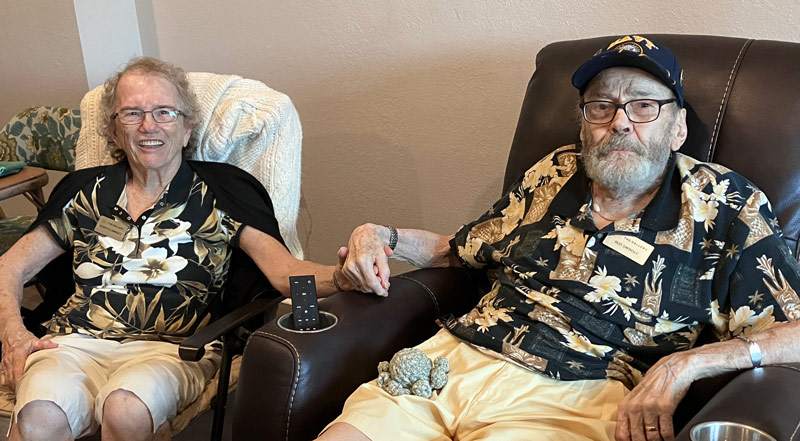
Roberta & Bud Swingle, 2025, in assisted living in Florida

Clarence E. Swingle, Jr., known as Bud, grew up in small bedroom with a sloped ceiling, no closet, and no room for a dresser, so he was allocated one drawer in his sister’s bedroom. A challenging time in his childhood was having to give up his collie dog, Snooks, to a friend’s home, when Bud’s family moved from Ulster, New York, to Sayre, Pennsylvania, which made him so sad that he never wanted a pet again. He graduated from Sayre High in 1950. 

A combination of family support, military service and the GI bill, self-advocacy, a mathematical mind, and hard work enabled him to build a comfortable life for himself and his eventual family.

His older sister, June, managed to enroll in nursing training. There wasn’t money for Bud to go to college, so his father, Clarence E. Swingle, Sr., got him a job as an office boy delivering mail among departments at Ingersoll Rand in Athens, Pennsylvania. Ingersoll Rand was also where Bud’s mother, C. Mildred Swingle, worked during World War II, operating a machine. She had started in the workforce as a teen, forced to leave high school as a sophomore to go to work after her father died.

Bud was also a hard worker. “They allowed me to work 9 hours a day, 5 days a week, and then 5 hours on Saturday,” he told his daughter by email in 2020 when she asked about his first job. “My pay was 80 cents an hour before taxes with no overtime pay, so my gross weekly pay was $40. I lived at home, so I was able to purchase a 1947 convertible Studebaker with payments in 1950. After a year, I requested a better paying job, and I ended up running a drill press at IR for $70 a week gross pay for a 40-hour week. I was really living now and still living at home.”

At age 20, facing being drafted, he enlisted in the U.S. Navy Air Force for four years, becoming an electronics technician radar/radioman on a Martin Marlin seaplane, part of squadron VP-48 from San Diego. They flew surveillance patrols off the coasts of Korea and China, out of Iwakuni, Japan, during and after the Korean War. One time, a patrol plane fired big guns at them, but missed, as they flew alongside taking pictures, an encounter written up in stateside newspapers.
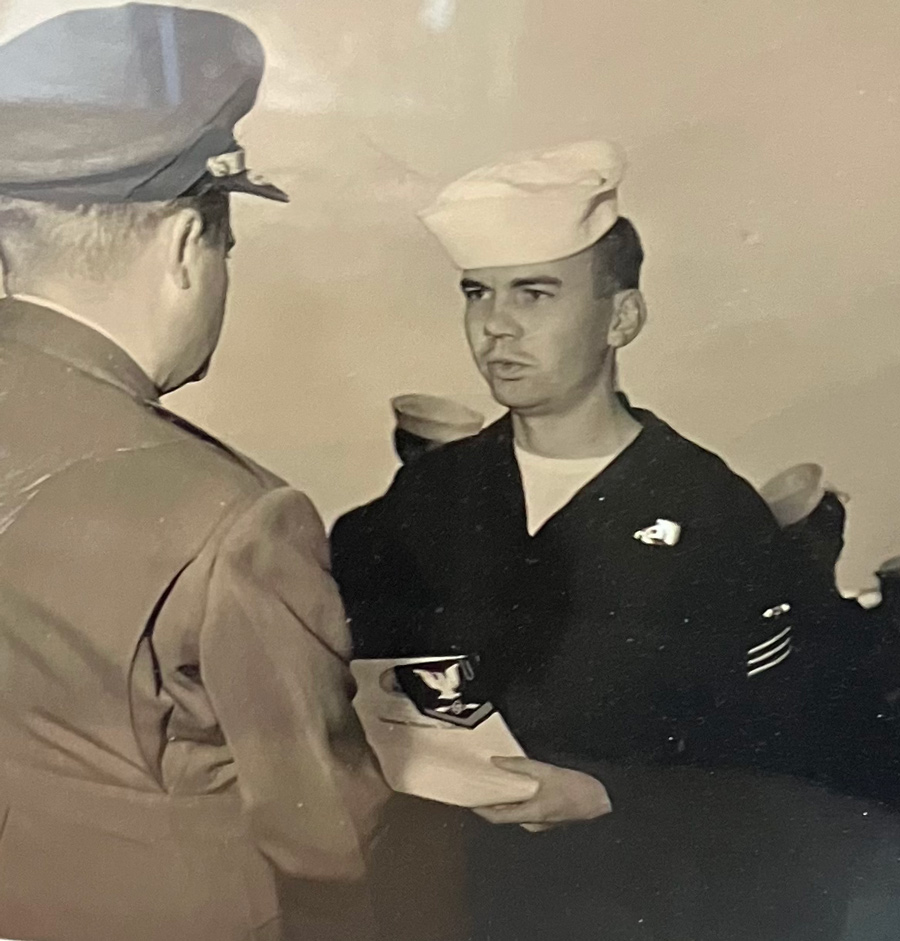
In the Navy

On their last flight in November 1956, they crashed during a night landing in Manila Bay in the Philippines due to pilot error. The plane sank in three pieces. Luckily the team survived.

Bud enrolled at Penn State in spring 1957, supported by the GI bill and his flight pay savings. He lived in a Quonset hut, surplus military housing that was needed to accommodate the post-war veteran enrollment surge. He graduated with his accounting degree in June 1960 and was hired at Eastman Kodak Co. in Rochester, NY. He asked to be a computer systems analyst, designing business computer systems, rather than their first offer of an accounting position. This was in the days when data and program instructions were entered on stiff paper punch cards. Through night classes at the University of Rochester over six years, he earned a master’s degree in business, while living in a mobile home park.

Thanks to his annual Kodak bonus, he was able to buy land on Keuka Lake in the 1960s, paid for over six years. He moved his mobile home there and rented a room in Rochester from a coworker, to be closer to Kodak during the workweek. 

He met his future wife, Roberta, at a St. Patrick’s Day dance in Rochester. He asked for her phone number but didn’t write it down, so she thought she’d never hear from him. But he’s long had a knack for remembering numbers, and he called. They were married on New Year’s Eve.
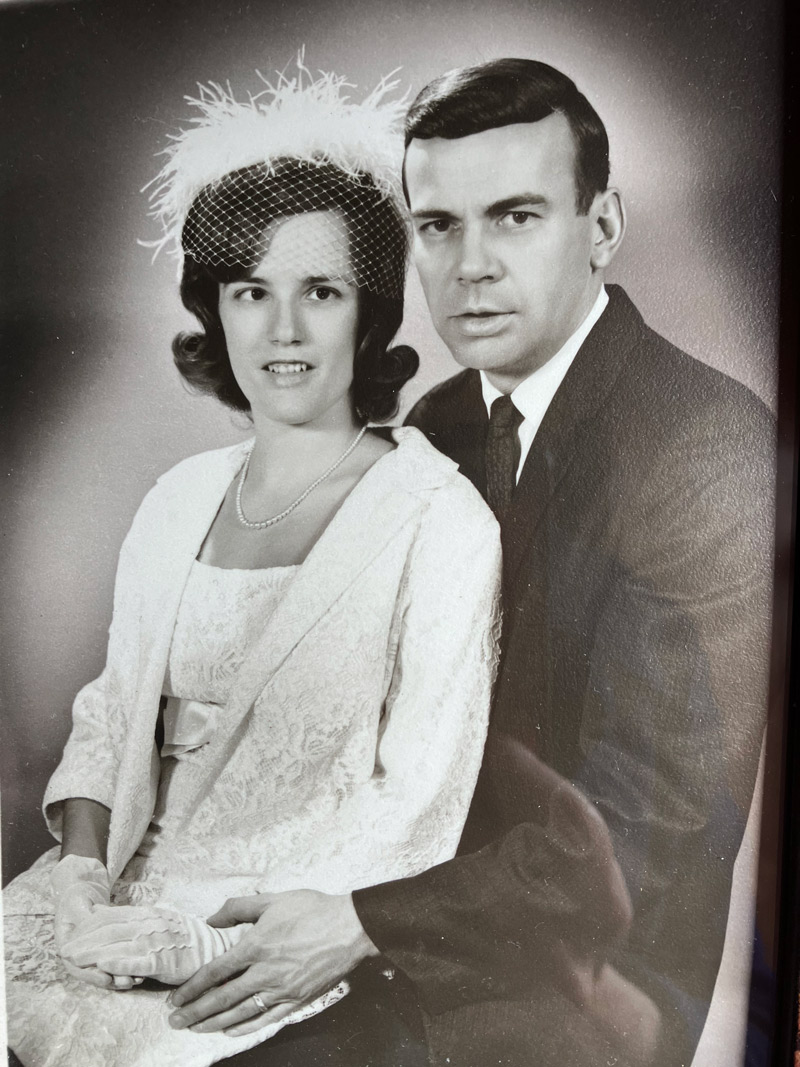
Wedding day

Their two children, Christine and Mark, grew up in Rochester and spent summers on Keuka Lake — with no TV and weekly trips to the Penn Yan town library. After high school, Bud and Roberta helped them go to college.
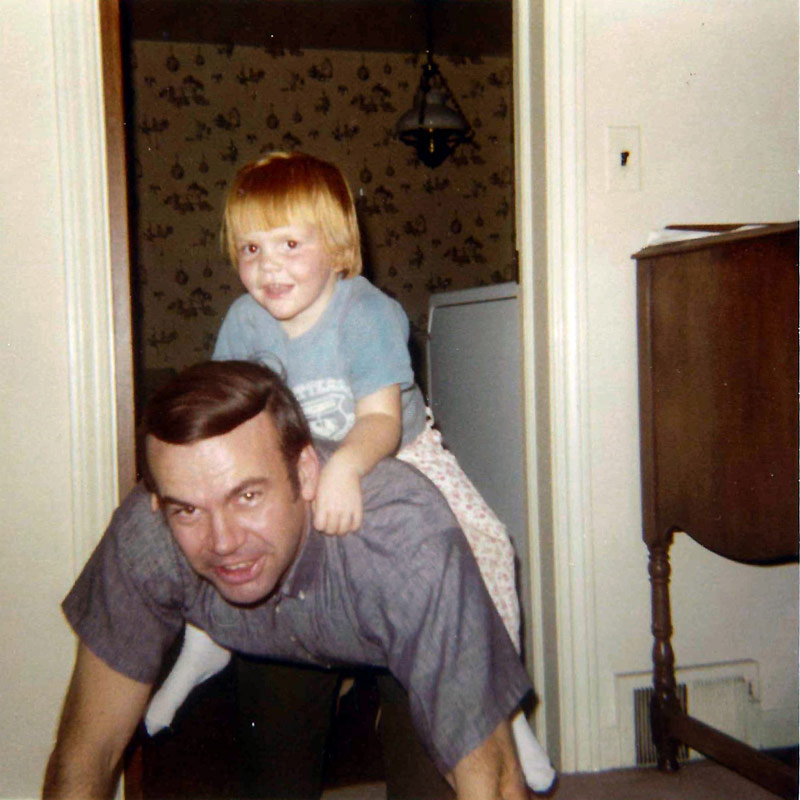
Horsey time with Chris

The family also had a mobile home in a senior community in North Port, Florida, where Bud’s parents spent four months each winter. Bud, Roberta, and the kids typically drove to Florida around Easter, including many 26-hour, straight-through drives south in a station wagon.

Bud’s father had long invested in stocks, and Bud did the same, which supported his retirement from Kodak in 1986 at age 54, as part of an early retirement incentive.

His family appreciates the many ways that Bud has been a good supporter of his family.

Chris with husband Tim, mom Roberta, son Mark, and Dad

Retirement has included taking care of his parents, who lived into their 80s and 90s, as well as enjoying cruises, playing bocce and bridge games, and dinners with friends. 
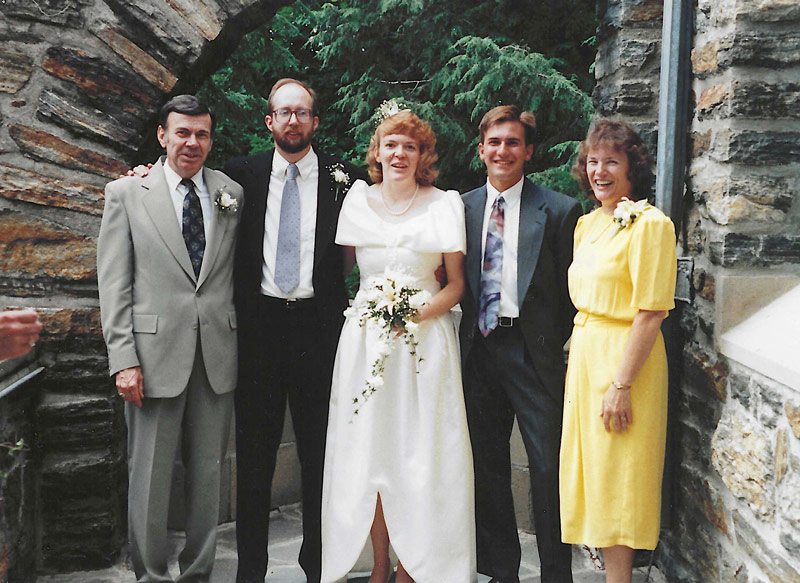
His daughter got married at Keuka Lake (above). For the wedding of his son, Bud returned to Japan, with his family (pictured below). 

Bud and Roberta have three grandchildren — two in Lawrence, New Jersey, and one in Brooklyn. 
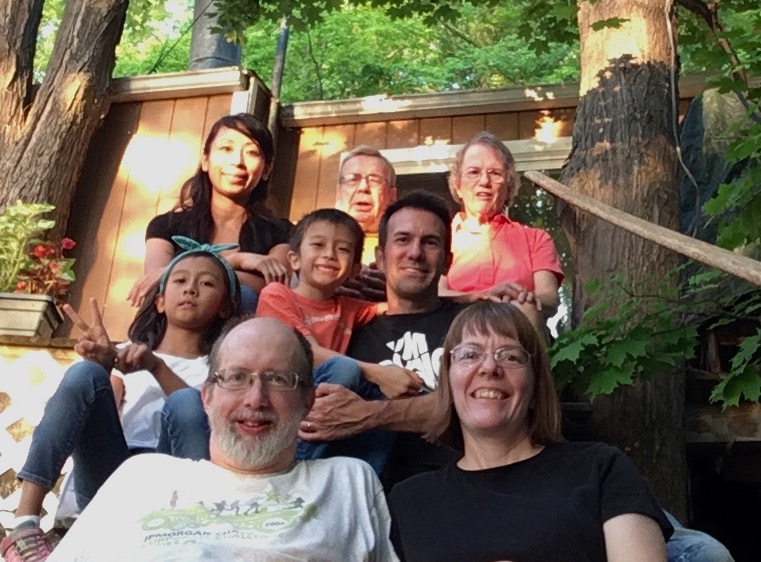
Yuki, Dad, Mom, Mia, Jion, Mark S., Tim, and Chris at Keuka Lake, 2017

These days, proudly wearing a Navy hat most days, he lives with his wife in North Port, FL.

Update: Dad died peacefully Oct. 19, 2025, at home, after 20 days of hospice support. He was 93.

He is survived by his wife, Roberta Swingle; his daughter, Christine Farnum (and spouse Timothy) and their son Mark Farnum; as well as his son, Mark Swingle (and spouse Yukiko) and their children Mia and Jion Swingle.

He chose cremation and did not want a service.

Cards may be sent to Roberta Swingle, 6801 Holo Court, North Port, FL 34287
1 Comment

Filed under Being grateful

What now? How do we find hope?

After this U.S. election, fears and tears are common. Many of us voted with hope for a future that favors equity, kindness, and care for people and our planet. What now?

First, take a break. It’s healthy to take time to grieve and rest. Be kind, to yourself and to others. Check in with people you care about. Especially people who feel particularly vulnerable under leaders that value certain people and dismiss or attack others.

Respect your own wisdom and skills. What’s helped you through other challenges in life? Use those strategies now. For me, that includes the deep breathing I practice in yoga classes. Also good: Regular exercise, spending time with caring people, and finding humor (including watching YouTube videos of late-night comedians). And eating chocolate. If you need more help, reach out to friends or professionals. This CBS News article has more strategies.

Then, regroup. Let’s not perpetuate “the autocrat’s goals of fear, isolation, exhaustion and disorientation.” So writes Daniel Hunter in “10 ways to be prepared and grounded now that Trump has won.” (Hunter also says to start by taking care of yourself.) Read his full article on Waging Nonviolence.org.

Unplug. You don’t need to read or listen to all the analysis, especially if it stresses you out more. Spend time with people.

Sleep. And then get up and outside in the daylight, even for five minutes. When we’re feeling out of sorts, we can forget the basics. The basics help.

Read or listen to something inspiring. “People kept the faith in the dictatorships of South America in the 1970s and 1980s, in the East Bloc countries and the USSR, women are protesting right now in Iran and people there are writing poetry.” — American writer, historian, and activist Rebecca Solnit, quoted in the.ink.

We can do hard things. A fellow water fitness instructor regularly says “We can do hard things” to encourage people during challenging moves. (It’s also the name of a podcast.) One exerciser said that mantra helped her get through physical pain recently. You are stronger than you realize.

Keep looking for hope. What we focus on matters. More women than ever will serve as U.S. governors. Delaware elected the first transgender member of Congress. Abortion rights measures won in seven of 10 states where they were on the ballot. And Trump can’t run again.

Updated Nov. 8 to add: “Research shows that hope is a powerful antidote to despair,” writer and research professor Brené Brown writes. “Right now, the thing that is helping the most is micro-dosing hope…. I am asking myself how I can support the people around me… how can I … stay committed to courage, kindness, and caring for others regardless of the choices made by others? Doing the smallest next right thing is hard AF, but sometimes it’s all we’ve got.”

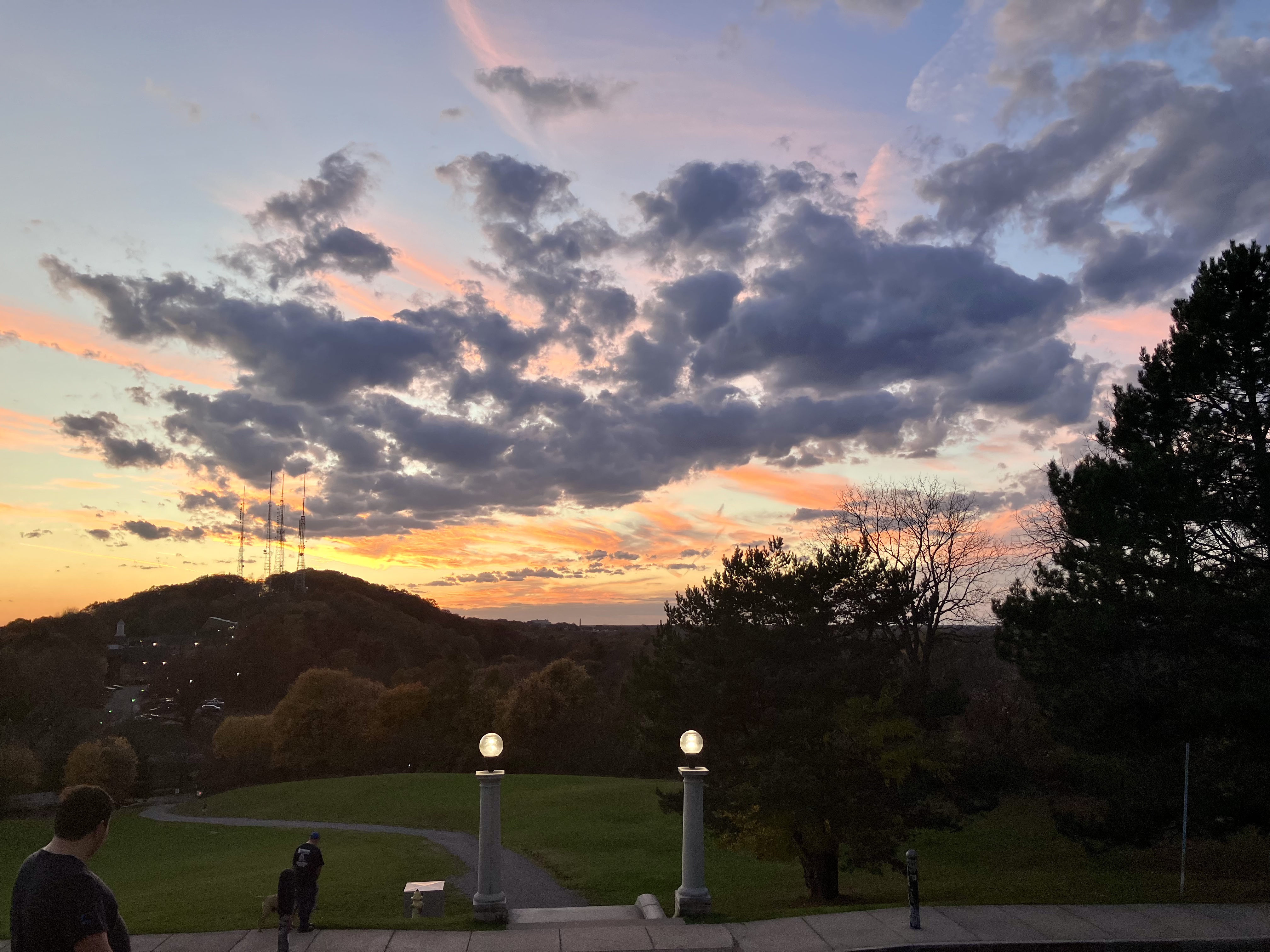
Sunset over Cobbs Hill on November 6, 2024, the day the presidential election results were called.

Leave a comment

Filed under Good ideas

Terrorism, Refugees, and Thanksgiving

turbansquash_canstockphoto22865140

Photo copyright: Can Stock Photo

On this Thanksgiving week, check out that turban squash as you consider the current debate: Should the U.S. shut its doors to Muslim refugees from Syria and Iraq in the wake of Islamic terrorists killing 130 people in Paris?

While reading about race and privilege, I came across this quote that also illuminates the refugee question.

Either we are committed to making a world in which all people are of value, everyone redeemable, or we surrender to the idea that some of us are truly better and more deserving of life than others, and once we open the door to that possibility, we cannot control it. … If we agree to accept limits on who is included in humanity, then we will become more and more like those we oppose.

— Aurora Levins Morales, author, from her book Medicine Stories. As a child, she was tortured by adults in Puerto Rico. She found a way not to hate them, so as not to become like them.

(Thank you to Miki Kashtan Ph.D., and to her Psychology Today blog post, for sharing that quote from her friend.)

So who are the refugees that some Americans want to keep out? Syrians are fleeing their homes because civil war has killed more than 240,000 people, including 12,000 children. Education, health care, and other infrastructure have been destroyed. Warring groups forcibly recruit children. If you were a citizen or parent there, wouldn’t you want to get out? These refugees are seeking safety. They are not the extremists who attacked Paris.

The L.A. Times editorial board pointed out yesterday:

Under the current resettlement process, potential refugees come almost exclusively through referrals from the office of the U.N. High Commissioner for Refugees, which vets their backgrounds before deciding which country to refer them to for resettlement. Those recommended to this country are then scrubbed by U.S. security officers through interviews overseas and biometric background checks, a process that can take up to two years.

…. [Meanwhile,] a forged passport could gain instant access.

Presidential candidate Donald Trump not only wants to exclude Muslim refugees from Syria, but also to track U.S. Muslims in a database.

In a rare political statement, the U.S. Holocaust Museum called out the similarity to the ordeal of Jewish refugees fleeing the Holocaust. The U.S. government rejected thousands back then, fearing they were Nazi spies.

We’re days away from Thanksgiving — that feel-good feast celebrating native Americans who welcomed pilgrims who came here as religious refugees from England. Turban squashes and all.

I understand that people are afraid. But decisions based on fear can do more harm than good.

“If we agree to accept limits on who is included in humanity, then we will become more and more like those we oppose.”

Learn more (1:50 video):

Syrian Refugees – Rumors vs. Facts by HuffPost Politics

Leave a comment

Filed under Learning

But I’m not racist….

“I treat people equally. I oppose racism. I’m not racist.”

I’ve thought that. between-the-world-and-me_cover

But lately I’ve been reading some thought-provoking writing that shifted my perspective. One is the 2015 book Between the World and Me by Ta-Nehisi Coates, which Toni Morrison says is “required reading.”

Ask yourself: Do you believe in the reality of “race”? Do you think there are really bone-deep features of some people? Choosing to categorize people as different is one way that slave owners justified mistreating other human beings. Why are we still seeing people as “other” today?

Or consider how you label yourself. Do you believe yourself to be white? The author uses that phrase, “people who believe themselves white,” which got me thinking. I would check “white” on a form that asks race, without thinking twice. But definitions of race change over time and vary by country. There may be things that some people have in common with each other, but you also could say that race is made up.

“…race, while it has some relationship to biology, is not mainly a biological matter. Race is primarily a sociopolitical construct. The sorting of people into this race or that in the modern era has generally been done by powerful groups for the purposes of maintaining and extending their own power.”

“…For purposes of the laws of nine southern and border states in the early part of [the 19th] century, a ‘Negro’ was defined as someone with a single Negro great-grandparent; in three other southern states, a Negro great-great-grandparent would suffice. That is, a person with 15 White ancestors four generations back and a single Negro ancestor at the same remove was reckoned a Negro in the eyes of the law.”

“…What is a person of mixed race? Biologically speaking, we are all mixed. That is, we all have genetic material from a variety of populations, and we all exhibit physical characteristics that testify to mixed ancestry. Biologically speaking, there never have been any pure races – all populations are mixed.

— Paul R. Spickard, Ph.D., “The Illogic of American Racial Categories,” PBS Frontline.

If some people in power, such as some police officers, have abused and even killed people, who’s responsible? It’s too easy to say it’s only the individual who choked or shot the victim. What cultural norms/expectations made that possible? Who pays that individual’s salary? (Hint: We, the taxpayers, do.)

Or consider: How have you benefited from being white? Or from presenting yourself as white? Access to a good public school, perhaps, because decades of housing policies — funded by our tax dollars — segregate people and schools. Perhaps connections to a job or to a college. Or just the luxury of expecting, as you walk down the street or into a store in the middle of the day, that you’ll be welcomed and treated kindly. My parents never had to have “the talk” about how to act so that I won’t be treated as a possible criminal.

Society is set up by people. What can we, as individuals, do to change it?


Great reading or watching:

I, Racist essay by John Metta.

Video: White bias in color film, and then in face recognition software.

Twitter: #RacismEndedWhen

USA Today story about my hometown, Rochester NY: Three boys apparently arrested for standing while black (waiting for the school bus).

Would you be as quick to hire Lakisha as to hire Emily? Racial Bias in Hiring 2003

A related New York Times article 2015: Racial Bias, Even When We Have Good Intentions

1 Comment

Filed under Uncategorized

What if you didn’t view conflicts as a problem?

You could view conflict as a sign that someone or something is wrong. That attitude makes conflict something to avoid and the solution would seem to be to control the other person or people.

Or you could see conflict as natural, occurring because people care. Something that can be handled. And if handled by “win-win” methods, conflict can be enriching and can help create new ways to cooperate.

In a conflict, it’s important to see what you have in common. If nothing else, we’re all human. Stay connected to the other person’s humanity.

That was one eye-opening message I took home from the first night of a 6-week course being taught by Kit Miller and Malik Thompson from the M.K. Gandhi Institute for Nonviolence in Rochester.

It’s so easy to see conflict as a problem. It mucks things up, right? But how much happier life could be if we can see someone’s contrary view as a sign that he or she really cares about the issue. Look for each person’s underlying needs. Assume we can find a way to meet them that serves both of us.

The course: Nonviolent Communication, an approach and training created by American psychology Marshall Rosenberg, Ph.D.  (1934-2015). Special thanks to First Unitarian Church of Rochester for hosting the classes.

lesstupid

Leave a comment

Filed under Being grateful, Good ideas, Learning

Beautiful blue

Blue, I say.

That’s my favorite color.

Like water. Like sky. Like water reflecting sky.

Image

Not sadness.

Harmony.

Image

Image

Image

Today’s blog post brought to you by the color blue.

Seagull/sky photo by Tim Farnum. Other photos by Chris Swingle Farnum.

Leave a comment

Filed under Being grateful

Ms. Lori’s experience at School 22

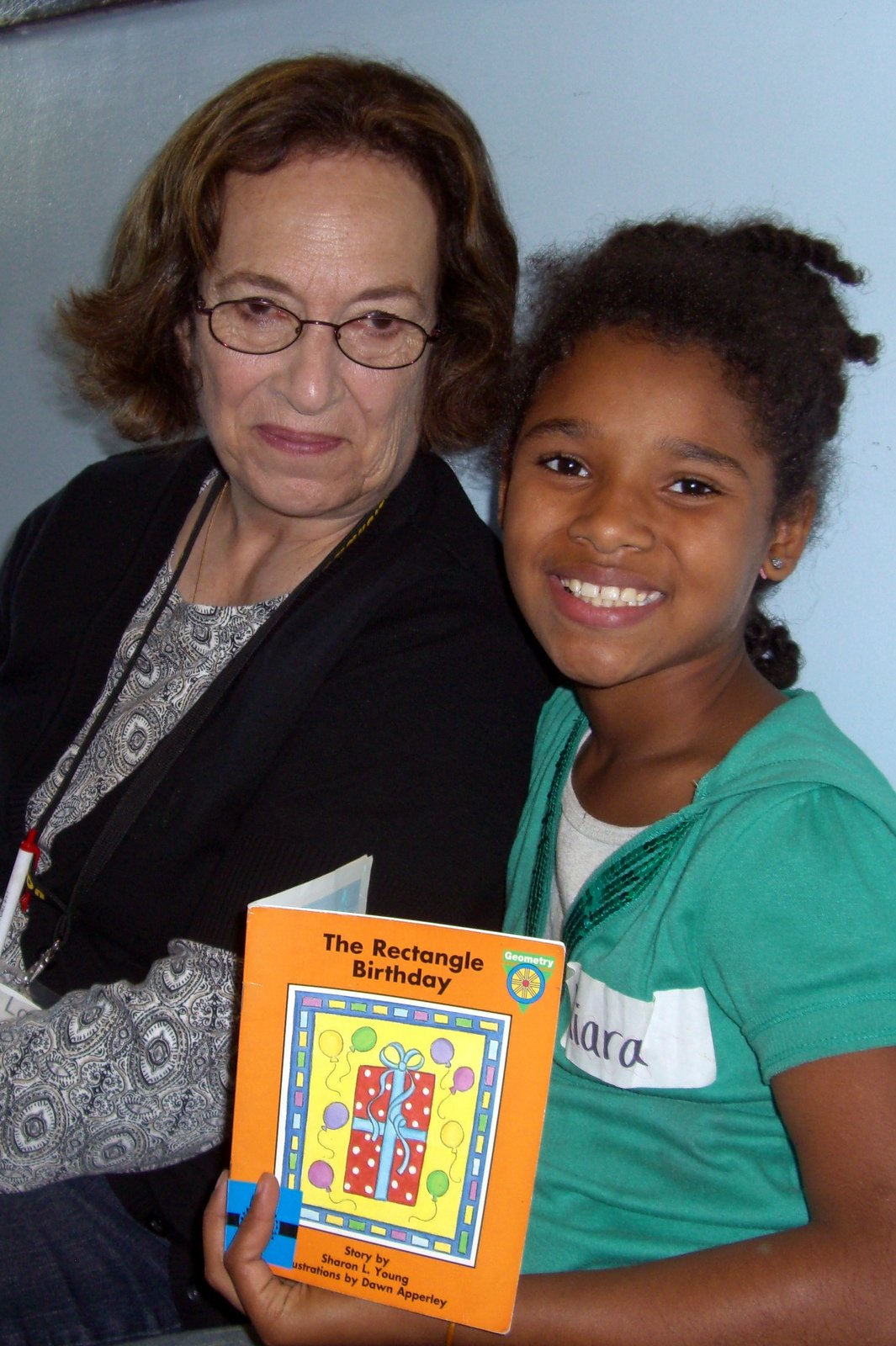
Ms. Lori is among the many great volunteers at School 22 in Rochester, giving about 2 hours every week to help several second-graders, and one third-grader, 1-on-1 with their reading.

The problem: Other students in the class come up to her. “Can you help me today?” they ask. She doesn’t have time to work 1-on-1 with everyone.

If only there were enough volunteers. Certainly many people aren’t available between 8 am and 4:15 pm (the school day and the after-school program time). But there may be false ideas that get in the way.

Adults may fear that they have to have a teaching background. They don’t.

They might think they need a lot of free time to help. But there are unfilled needs that are just 45 minutes a week.

They might wonder what it’s really like. So I’ve created a 2-minute video showing Ms. Lori’s experience at School 22.

To watch the video, click here.

To learn more about this community-school partnership, click here.

1 Comment

Filed under Being grateful, Good news, Rochester City School District

Solving urban education

P1000741 If you saw a child drowning in a river in front of you, you’d rescue the child, right? And then if there was another, and another? For 25 years, my church (First Unitarian Church of Rochester) has been reaching out a hand to city school students who need help to succeed in school – and in life. It’s critical work and it makes a difference in children’s lives.

I’ve been wrestling with the root problem: How do you prevent children from winding up struggling in the river? You want to go upstream. Stop whoever is pushing youngsters in, or fix the weak place where they’re falling in. But I don’t see one cause of urban education failure that can easily be fixed.

The long list includes broken families, lack of jobs, crushing poverty, teen pregnancy, child abuse, language barriers and the stress of a parent’s mental illness or drug/alcohol addiction. Don’t forget racism, prejudice, inequitable incarceration policies and unequal school resources. It’s not so easy to walk to school if your neighborhood is unsafe.

I think many people throw up their hands and try to ignore the river. But we need to consider our role, as a society, in creating the river. And lately the waves have gotten bigger with tougher standards.

Imagine a long staircase. Many poor, urban students start on the first step, arriving atImage kindergarten without knowing letters, how to count or sometimes even the names of colors. One study found that by the age of 4, children in poor families have heard 32 million fewer words than the children of professionals. But in a middle-class setting, many children start kindergarten already about six steps ahead, so it’s not hard to get them to “proficiency” on, let’s say, the seventh step. When low-income students work hard and have great help from teachers and volunteers and climb from the first to the fifth step, they’ve made incredible progress. But they’re still failing in the eyes of the state. Now the state has raised the bar to expect everyone to reach the eighth or ninth step.

Why has our community created school district boundaries that effectively segregate poor students? How do we expect to educate students who start out so far behind, and have great stresses in their lives, at the same costs as more advantaged students?

While wrestling with the big picture, we can’t ignore the children who are struggling right now. The first step toward change is to form connections. By being in the schools, tutoring students during the school day, we get to know people and better understand the issues and the needs.

In the past two years, we’ve tripled the size of our school volunteer program.  I am proud of the dedicated work of more than 100 volunteers last year to help children climb out of the river and up the steps.

More volunteers are needed. For information, see www.rochesterunitarian.org/22UUCS.html

1 Comment

Filed under Rochester City School District

Why I like writing

This week I interviewed a local artist about how she is evolving into a consultant. I created a text story and a viImagedeo for the Rochester Professional Consultants Network e-newsletter, which publishes at the end of this month.

As we talked about her unusual art form and about the artisans group she created, I was reminded why I enjoy my professional writing career.

I get to meet and interview fascinating people who do interesting work and have intriguing ideas. I have the privilege of telling their story so that others get to know them. And as in this case, when the person reads the story and says it’s exactly right, I have the satisfaction of a job well done.

Every story, just like every person, is unique. I appreciate that my writing work enables me to continue to  learn and grow.

August 2013 RPCN newsletter (including the article about artist Stefani Tadio), and video.

1 Comment

Filed under Being grateful, My freelance writing

What I learned from Mike

One thing I’ll remember about our friend Mike, who died suddenly in April, was the way he liked to joke around and have fun. He insisted to children that cantelopes “grew” in the lake and floated to the surface — look, there’s one now! — when they were ready to harvest.

One thing I’ll treasure about Mike was his example of how to include children in group gatherings, in ways that make clear that they’re valued and capable.

Image

Each summer, about 30 friends and relatives with ties to Rochester gather at Mike and Bob’s summer cottage in the Adirondacks. The weekends are intended to be a mix of work and play. Our hosts plan a list of home improvement projects, such as painting exterior walls, building sheds and leveling the cottage by adjusting piers underneath. There are typically some more questionable tasks, too, such as moving rocks around the property or “cleaning the forest,” which involves raking leaves and hauling away fallen branches.

Mike always assigned each guest to a specific task, typically in teams of three to five people. He included every child, even those under age 5, on a team. One time, kids helped paint a shed. They might not last very long on the project. But they do their part. Last summer, the kids all painted birdhouses, where were then hung on a tree. (Photos above and below.)Image

Toward the end of each weekend, we gather to reflect – and joke – about “what we learned” that weekend. Kids are always included in those discussions, too. Their comments and insights are often a delight. I’m grateful for the wise example of treating each and every person as important, regardless of age. Mike was great at building community.

Over the past year or so, I’ve led multiple volunteer crews from my church at Foodlink, the regional food bank. Foodlink sets a minimum age of 8, and we’ve had volunteers from age 8 to close to 80. The task includes counting out dozens or even hundreds of cans, boxes or packets of food. We have to do math to calculate how many cases of each food item we’ll need to pack specific numbers of food bags.

Like Mike, I aim to include each volunteer equally and appreciate their contributions. It warms my heart to see kids rise to the challenge of the math calculations, counting, carrying and packing. When they need help, I’ve watched them team up with another child or adult to get the task done. Their new buddy might be someone they just met, and their shared task helps build community.

Image

Callan (holding bag) with other church volunteers at Foodlink

Callan, who’s 9, told me that the work makes him feel capable and useful: “I just helped a lot of kids get food that they needed,” he says. He also likes getting to know new people from our large congregation, and he shares a neat connection with them when they cross paths later at church.

Callan and his sister, 11-year-old Madi, are such fans of the volunteer work that they have recruited friends to join in.

Cheryl, mom of Callan and Madi, says the work gives her kids a boost of confidence.

Amen.

Rest in peace Mike Losinger.  April 10, 1941 – April 17, 2013

CIMG8789

Sunset at Mike & Bob’s cottage on Mountain Lake, Adirondacks, NY

1 Comment

Filed under Being grateful